Terre Haute

Terre Haute - A history and a guide

This is my history and guide to my adopted home - Terre Haute, Indiana.

Old Postcards - 3

Some notes on the postcards

Variations

Postcards, for the most part, are a "cheap and cheerful" product not high art and some colour variations in the cards of the same series do occur. For a while, whenever I saw a card that had a different cloud pattern in the sky I thought it must be a different series of card, but I was wrong. This variation was due to the way that early postcards were tinted. The postcard manufacturers either had their own artists or would out-source the work. For this reason there are variations between batches of the same series of cards and the colours used may bear little relation to he actual colours of the buildings themselves. The Vigo County Historical Society makes this clear on their own postcard collection page.

Some postcards used the same photograph but were issued by different publishers with different tinting, cropping or some other type of manipulation such as in this series of postcards of Indiana State Normal School...

These cards were produced at different times by the Illustrated Post Card Co., S. H. Knox & Co. and Bundy

Generic Cards

Some cards are obviously generic, such as this "Dutch" series...

Some cards are a little more subtle...

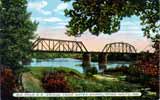
The Wabash River at Terre Haute and Vincennes?

Both were made by Curt Teich and have the Art Colortone text  - Genuine Curteich-Chicago "C.T. Art-Colortone" Post Card (Reg. U.S. Pat. Off.)
Both have the same number - 6A-H968
The Terre Haute card was published by the Wabash Valley News Agency, Terre Haute, Ind.
The Vincennes card was published by A. A. Arnold, Vincennes, Ind.

Bill Judnick has a nice article called "Generic Postcards - Explained and Illustrated"

Dating Postcards

There are already plenty of sites that have a lot of useful information about dating postcards, so rather than rewrite what's already been written I'll simply put links to them...

A Brief Guide to Identifying and Dating Postcards in the US
Frith Postcard Reference Number Dates
Guide to Dating Curt Teich Postcards
Guide to Dating Old Postcards
How To Date U.S. Postcards by Postage Amount
Postmark Dated Curt-Teich Cards
Postcard Dating Guide
Real Photo Postcard Stamp Boxes - How to Identify Real Photo Postcards
Tips for Determining When a U.S. Postcard was Published

Most of the above guides deal with the type of postcard and the various markings and numbering system the manufacturers used, but a rough date can often be determined by the buildings, clothing, vehicles and other items in the postcard picture itself. What people wrote on the back of the card can also provide useful information...

This page created 25th March 2008, last modified 25th March 2008

The text says...

Terre Haute, Ind. Looking North in Seventh Street from Wabash Avenue; showing Government Building, Grand Opera House, and Rose Dispensary.

This used, (but I cannot read the date) postcard has the following text...

Printed in Germany
Book Dep't Root Dry Goods Co.
Raphael Tuek & Sons' Post Card Series No. 2017. "Terre Haute, Ind."
Art Publishers to Their Majesties The King and Queen

This view shows three main buildings, The Post office & Federal Building on the left, behind which is the ornate Rose Dispensary and opposite then on the right, is the Grand Opera House.

The old Post Office stood on the southwest corner of Cherry and Seventh Streets and was built in 1884. It was demolished in 1932 and the site used for a new Federal building. parts of this old building was used in the Chauncey Rose Memorial that stands in Fairbanks Park.

The Rose Dispensary stood on the northwest corner of Cherry and Seventh Streets and the construction of it started in 1894. Indiana State University purchased it in 1970 and it was demolished in 1972 to be replaced by Oakley Plaza - the North Seventh Street entrance to the ISU campus.

The Grand Opera House stood on the southeast corner of Cherry and Seventh Streets  and was opened on November 2nd, 1897. In the 1930's it was converted to a movie theatre and renamed the Grand Theatre. It was demolished in 1960 and the site used by Terre Haute House as a parking lot.

From the dates of the buildings, the photograph used for the postcard must have been taken between 1898, when the Grand Opera house was opened, and 1932, when the old Post Office was demolished.

Turning the card over, there are other clues to the date of this card...

Back of the above postcard

The card has an undivided back and has the words "Post Card".

From December 24, 1901, the Government allowed postcard manufacturers to use the words "Post Card" instead of "Private Mailing Card". The "undivided back" was reserved for the address and one cent domestic postage or two cent foreign postage. From March 1, 1907, manufacturers were allowed to use a divided back, the right side panel was for the address and the left side for writing messages.

So, with a little detective work this card can be dated to somewhere between 1901 and 1907.

Another example of using a little detective work is the following postcard of Vigo County Fair Grounds...

Vigo County Fair Grounds

Vigo County Fair Grounds

This used but unstamped postcard has the text...

The largest county fair in the Wabash Valley held annually at the Vigo county Fair Grounds, south of Terre Haute, Indiana, on U.S. 41. 4-H Fairs, USAC Auto Races, Western Horse Shows, Women's Exhibits, Harness Racing, fine Beef judging and terrific Grandstand Shows are a few of the features to be found at the Vigo County Fair Grounds.

Ektachrome Photo by Kadel
Pub. by Kadel Photographers, Terre Haute, Indiana
K-20A
94966-B
Dexter Press Inc.

The back of this card has an interesting story...

The first, left hand written text says...

Dear fan:
Hope to see you Sunday, June 16th for the U.S.A.C. Sprint Car races at the famous Terre Haute action Track. Hurtibise [sic] will be trying for this 6th straight win.
Don Smith

The right hand written text says...

This was Leonards [the addressee] gift for Father's Day
Ate at Spagetti [sic] Place in Clinton

Using a bit of detective work this card can be dated fairly accurately...

Don Smith is a well-known figure in Terre Haute. He is the chairman of the board of Terre Haute-based First Financial Corporation, a major sponsor of local short-track racing in Indiana. He is also a former promoter of the Terre Haute Action Track and founded the Sumar Racing team with Chapman S. Root which raced from 1953-1960. Jim Hurtubise's NASCAR and USAC racing career spanned the years 1957 to 1977 but his best years seem to have been from 1960 to 1964. June 16th falls on Sunday in certain years, for example, 1957, 1963, 1968, 1974 and 1985. Therefore, I think this card dates from 1963.

Looking After Postcard Collections

No matter what condition a card is in, once it is in your possession you should do your best to look after it and stop it deteriorating. There are several companies that specialize in protectors for paper products such as BCW, Collector Safe and Ultra-Pro. Whatever type of protection you use they should be archival quality and acid free. Some brands also pass the PAT (Photographic Activity Test).

Soft Sleeves

Most of these inexpensive sleeves are made from 2 mil polyethylene, polypropylene or polyester (Mylar). Of these, Mylar is used for professional archival purposes but is more expensive than polyethylene or polypropylene. Flexible (plasticized) PVC (Poly Vinyl Chloride) sleeves should not be used as the plasticizer can leach and the chloride can decompose causing damage to whatever is in the sleeve.

The most common material for these sleeves is polypropylene, but Bags Unlimited sell 2 mil and 4 mil soft sleeves made from polyethylene. I was a bit disappointed when I ordered a pack of each of these as these sleeves, despite being labeled "Extra Clear" are nowhere near as transparent as those made from polypropylene. Surprisingly however, when a postcard is placed inside them there really is hardly any difference between the polypropylene and polyethylene sleeves.

The problem with soft sleeves is that while they protect against scuffing and most damage caused by handling they cannot protect against bending and creases. The 4 mil sleeves are obviously thicker than the 2 mil sleeves but they will not prevent the postcard from creasing if they are bent.

Rigid Sleeves

These are also called toploaders (the opening is on one short side) or sideloaders (the opening is on one long side). Nearly all the rigid sleeves I've seen are made from 16 mil rigid (unplasticized) PVC, and are produced by the same companies that produce the soft sleeves.

One thing I find disconcerting is that while there is plenty of information regarding how harmful the plasticizers are in PVC, I cannot find any information on how safe these rigid PVC sleeves are for long term storage of postcards or other paper products. I think the manufacturer's also have the same problem. for example, BCW's 2 mil polypropylene soft sleeves have "No PVC" printed on the packaging as if all PVC might be harmful. Ultra-Pro has "Archival Safe" printed on the packaging of their 2 mil polypropylene soft sleeves, these words are missing from their 16 mil uPVC sleeves. However, it is possible to place the postcards inside soft sleeves and then place them inside the rigid sleeves.

Boxes

There are plenty of providers of storage boxes for postcards. The best kind are advertised as being "alkaline buffered and lignin free". Lignin is a natural product found in wood fibre and can make paper products darken when exposed to light. Many people use shoe boxes, but these should be safe so long as the individual postcards are kept in sleeves.

Albums

I like the idea of using albums to store and show off postcards. There are some problems with albums though. Many people pasted postcards into old albums, usually those made of heavy, black Kraft paper. Doing this ruins the back of the postcards. Not only that but the paper is not archive quality and the acid in it will eventually damage the postcards. The corners used for stamps can be used, but these need to be acid-free. The problem with paper album pages is that the backs cannot easily be seen and for many postcards the backs are nearly as interesting as the front.

There are several types of plastic postcard albums around. Use the type where pages can be easily added or removed - this prevents lots of handling of the postcards as they are rearranged. Some people like to add two postcards to each slot in these pages. Again, these hide the back of the postcards so I prefer to use only one. Some postcards album pages are designed to fit standard 3-ring binders but this means that the four standard postcard (3 1/2 by 5 1/2 inches) size sheets are placed at right-angles to the spine. Pages for the continental and modern size postcards (4 inches by 6 inches) only hold three cards - two vertically and one horizontally. I prefer the larger album pages where each can hold 4 of postcards horintally.

Be careful when choosing pages for the album as some slots are a very snug fit and the corners of the postcards can be damaged by taking them in or out of the individual pages.

The website at Oldpostcardsforsale has a page of great tips for keeping collections of postcards.
Paper - What It's Up Against by Artlab
Postcard Storage Ideas
Postcards: Navigating the Preservation Options by Jan Merrill-Oldham
Preserving Treasures
 

Other Postcard Resources

First Aid for Postcards
List of Ellis Real Photo Postcards by Number and Caption
List of Known I & M Ottenheimer Postcards
Postcards and Postcard Collecting - a great site of articles and links
Postcard Publishers
Ross Verlag Movie Star Post Cards Checklist

Other City & State Postcards

Arnprior , Ontario
Chicago, Illinois
Effingham County, Illinois
Iowa
Johnson City, Tennessee
Muskogee, Oklahoma
New York State
New York, New York
New York, New York
Penny Postcards by State
Portland, Oregon
Rochester, New York
Terre Haute - Hometown with Tom Roznowski

This page created 25th March 2008, last modified 1st May 2008